Rev. Dr. Mark David Albertson
Introduction: The Other Chris… I Mean, Simon
Have you ever been mistaken for someone else with your same first name? Maybe in school, where the teacher kept saying the other kid’s last name because you were both “Mikes.” Or maybe in church, when someone says, “Oh, you’re the other Chris.” It’s humbling. You suddenly become a shadow of someone else’s identity.
Now imagine being a disciple of Jesus, handpicked for the Twelve, and every time your name comes up, it’s followed by a pause: “Simon… oh, not that Simon. The other one.”
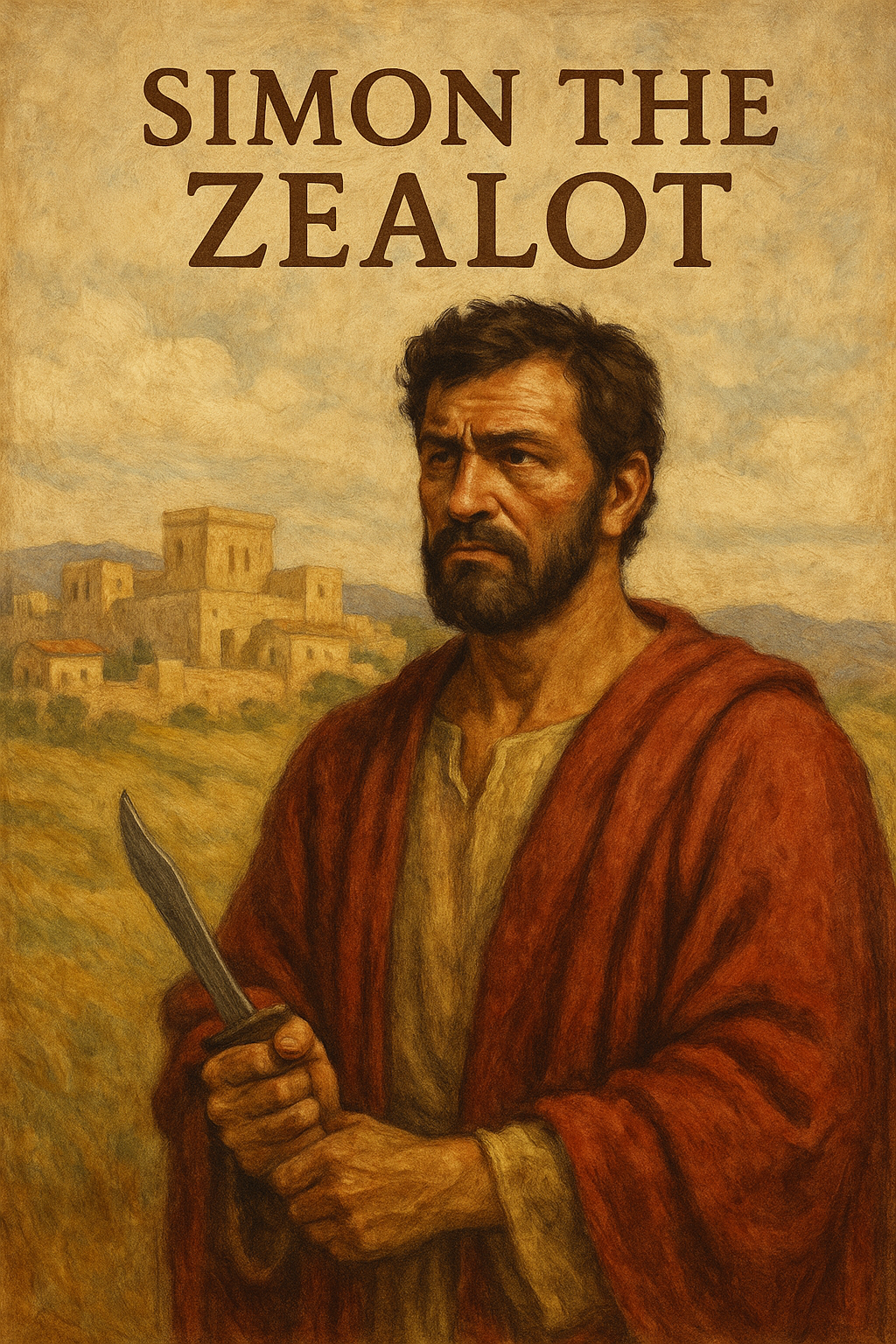
On one side of the story is Simon Peter—the rock, the preacher at Pentecost, the one who gets entire chapters about his triumphs and failures. On the other side, there’s Simon the Zealot. No spotlight. No walking on water. Just a name in the lists of disciples and one little label: “the Zealot” (Luke 6:15, Acts 1:13).
It might feel like a throwaway detail, but that word “zealot” is a doorway into his life, his world, and what it means for us today. Sometimes the forgotten names in Scripture teach us the biggest lessons.
What Does It Mean to Be a Zealot?
When you hear the word “zealot” today, you might think of someone who is just way too into their thing. The neighbor who’s still flying their team’s flag in March even though the season ended in December. The cousin who cornered you at Thanksgiving to explain bitcoin for the 11th time.
But in Simon’s day, “zealot” wasn’t just about personality quirks. It was political, dangerous, and deadly serious.
First-century Judea was under Roman rule. Soldiers patrolled the streets. Taxes flowed into Rome’s coffers. Roman governors lived in palaces while ordinary Jewish families scraped by. And on top of that, Caesar was treated as divine, with his image stamped on coins that people had to use in everyday life. For faithful Jews, this was idolatry baked into the economy.
Different Jewish groups responded in different ways:
- Sadducees cooperated with Rome to maintain influence.
- Pharisees doubled down on purity and law-keeping.
- Essenes withdrew into desert communities like Qumran.
- Zealots? They sharpened knives.
The Zealots believed only God should rule Israel. They rejected Roman occupation not only as unjust but as blasphemous. Some historians describe them as guerrilla fighters, willing to assassinate Roman officials or Jewish collaborators. Josephus, the Jewish historian, paints them as fiery nationalists who helped spark the Jewish revolt of 66–70 CE, which ended with the destruction of Jerusalem and the Temple.
So when you read “Simon the Zealot,” don’t imagine just a passionate personality. Imagine a man who, before Jesus, might have dreamed of overthrowing Rome with force. His passion burned hot enough that everyone knew him by it.
And yet Jesus called him.
Jesus’ Crazy Roster Choices
If you were launching a new movement to change the world, who would you pick for your inner circle? Probably not fishermen, tax collectors, and zealots. And definitely not all of them in the same room.
But Jesus does exactly that. He chooses Matthew, the tax collector—someone who had worked for Rome, taking money from his own people. Then he chooses Simon the Zealot, who likely despised people like Matthew.
Can you picture the first potluck?
- “Matthew, you’re on bread duty.”
- “Simon, maybe don’t bring your dagger to the fellowship hall.”
This wasn’t a random accident. Jesus wanted these two at the same table. He didn’t erase their differences. He didn’t smooth over the conflict. He put them side by side and said, “Follow me.”
That’s the gospel in miniature: enemies sharing bread, not because they agree, but because Jesus is at the head of the table.
The Two Simons
Now let’s put Simon the Zealot next to Simon Peter.
Peter is the disciple who dominates the Gospels. Bold, impulsive, passionate, often wrong at full volume. He jumps out of boats before checking the wind. He promises faithfulness one minute and denies Jesus the next. He’s famous for action.
Simon the Zealot gets no stories, no speeches. Just a title. Yet, if his nickname tells us anything, he shared Peter’s fire. Peter carried swords and swung them clumsily. Simon carried zeal like a flame under his skin. Both had to learn how to redirect their passion.
Jesus doesn’t erase personality. He baptizes it. Peter’s boldness becomes leadership at Pentecost. Simon’s zeal becomes a steady flame of faithfulness. Both men go from wielding weapons to carrying towels.
Fire in the Right Hearth
Think of zeal like fire. Fire isn’t good or bad—it just is. Fire warms your home or burns it down, depending on where you place it.
Simon’s zeal could have destroyed. But in Jesus, it became a gift. Instead of burning against enemies, it burned for the kingdom. Instead of fueling violence, it fueled mission.
Zeal outside the kingdom says: “I will force the world to be right.”
Zeal inside the kingdom says: “I will follow the One making the world right—even when it costs me.”
The fire is still hot. But Jesus gives it a hearth.
Zeal Meets the Sermon on the Mount
Imagine Simon sitting in the crowd at the Sermon on the Mount, ready for a rallying cry. He wants Jesus to say, “Rise up! Drive out Rome!” Instead, Jesus says:
- “Blessed are the peacemakers.”
- “Love your enemies.”
- “Turn the other cheek.”
Simon must have bristled. “Love your enemies? Pray for them? That’s not how zeal works, Jesus!”
But over time, Simon learned what we all must: the way of Jesus is harder, braver, and holier than revenge. Loving enemies requires more courage than stabbing them. Carrying a cross takes more strength than carrying a sword.
Simon’s Silence
After the Gospels, Simon disappears. He’s mentioned in Acts 1:13 among the disciples waiting in the upper room. After that, silence.
Tradition says he may have traveled as a missionary—some say to Persia, others to Egypt or even as far as Britain. Some traditions say he was martyred. But the Bible itself leaves him nameless in history, a quiet presence.
Maybe that’s the point. Not every disciple is Peter or Paul. Some of us live faithful, fiery lives without the spotlight. Simon is remembered for being there, for being faithful, for letting Jesus redirect his zeal.
Sometimes faith looks like loud preaching. Sometimes it looks like quiet presence. Both matter.
First-Century Zealotry and Us
It’s easy to leave zealotry in the first century, but we live with our own versions. Our zeal doesn’t usually involve daggers in cloaks, but the passion is the same.
Modern zealotry shows up in politics, where people treat opponents as enemies to destroy instead of neighbors to love. It shows up online, where zeal spills into social media arguments that burn hotter than truth. It shows up in churches, where fights about music style or carpet color become battles instead of conversations.
Zeal itself isn’t the problem. The problem is zeal without Jesus. Fire without a hearth burns everything it touches.
But zeal with Jesus? That’s where the world sees something different. Not apathy. Not indifference. Passion redirected toward love. Energy spent not on winning but on serving. Fire that warms, not burns.
A Story of Zeal Redirected
I remember watching two men in a church kitchen—one conservative, one progressive, both opinionated. For years they avoided each other. Then they ended up prepping meals together one Tuesday night.
At first, they bickered about everything: canned beans versus fresh, how spicy the chili should be, whether styrofoam bowls were “eco-friendly enough.” But then a young mom walked in with two kids, asking for food. Without hesitation, both men moved. One ladled chili. The other packed fruit cups. Both served.
They didn’t solve their disagreements. They didn’t change their minds. But in that moment, their zeal found a new center: loving neighbors in Jesus’ name.
That’s the kingdom.
What Simon Might Say to Us
If Simon could speak today, maybe he’d say:
- “I thought zeal meant fighting Rome. Jesus showed me zeal means loving enemies.”
- “I thought zeal meant force. Jesus showed me zeal means sacrifice.”
- “I thought zeal meant winning. Jesus showed me zeal means resurrection.”
He didn’t lose his fire. He just found a better hearth.
The Takeaway
So what do we learn from Simon the Zealot?
Jesus doesn’t erase zeal. He re-centers it in love and seats it next to an enemy.
That’s the gospel at table height.
Conclusion: The Other Simon Still Speaks
Simon may be “the other Simon,” but his presence speaks volumes. He reminds us that Jesus calls both the passionate and the cautious, both the loud and the quiet, both the zealot and the tax collector. He shows us that our fire is not meant to be extinguished but transformed.
We live in a world that desperately needs people like Simon—people whose zeal is no longer destructive but healing, no longer angry but hopeful, no longer weaponized but Christ-centered.
So let the lesson of Simon the Zealot echo: Don’t lose your fire. Give it to Jesus. Let him baptize it, redirect it, and seat it right next to someone you once called your enemy.
Because at the head of the table sits Christ—the only one whose zeal truly saves.